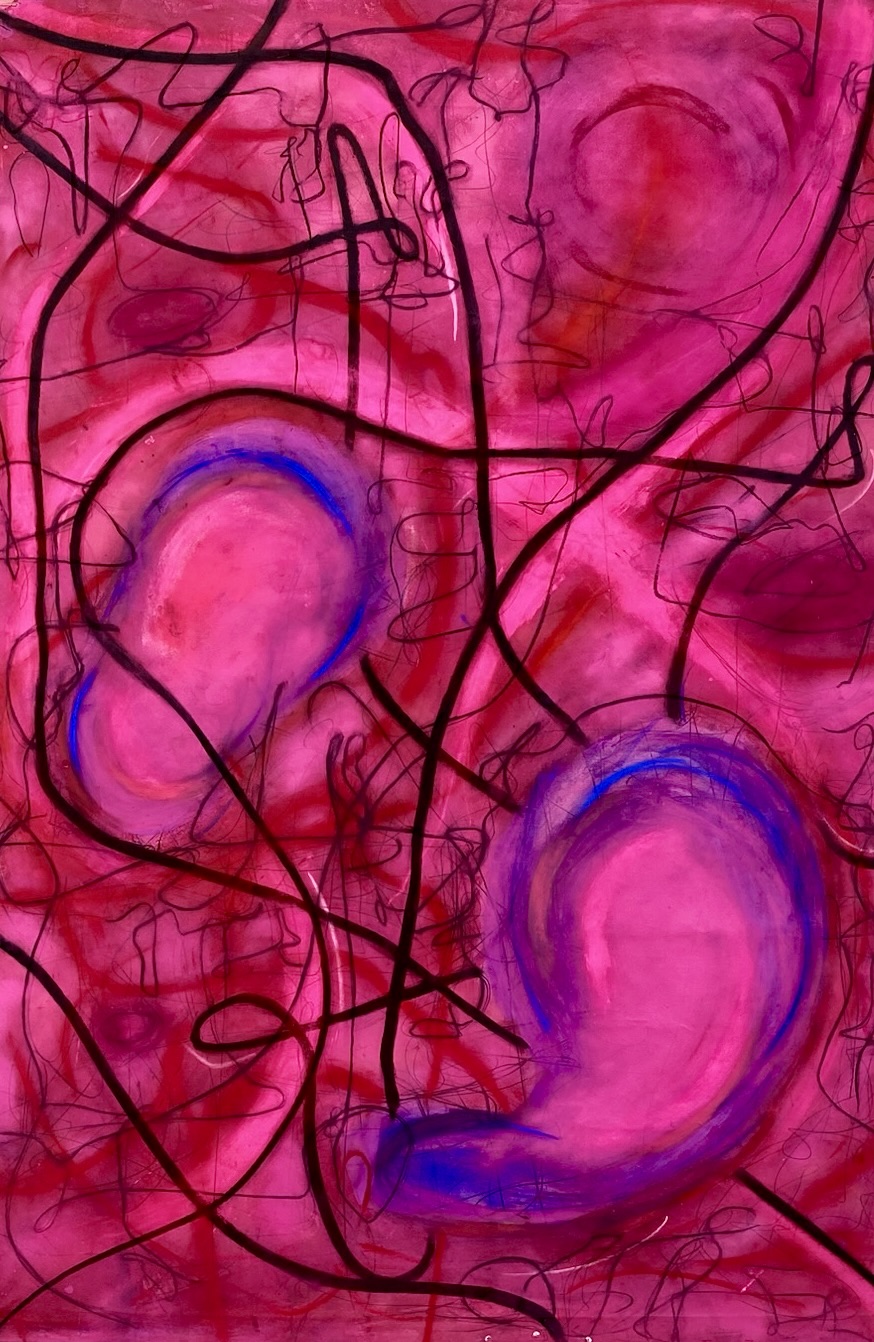
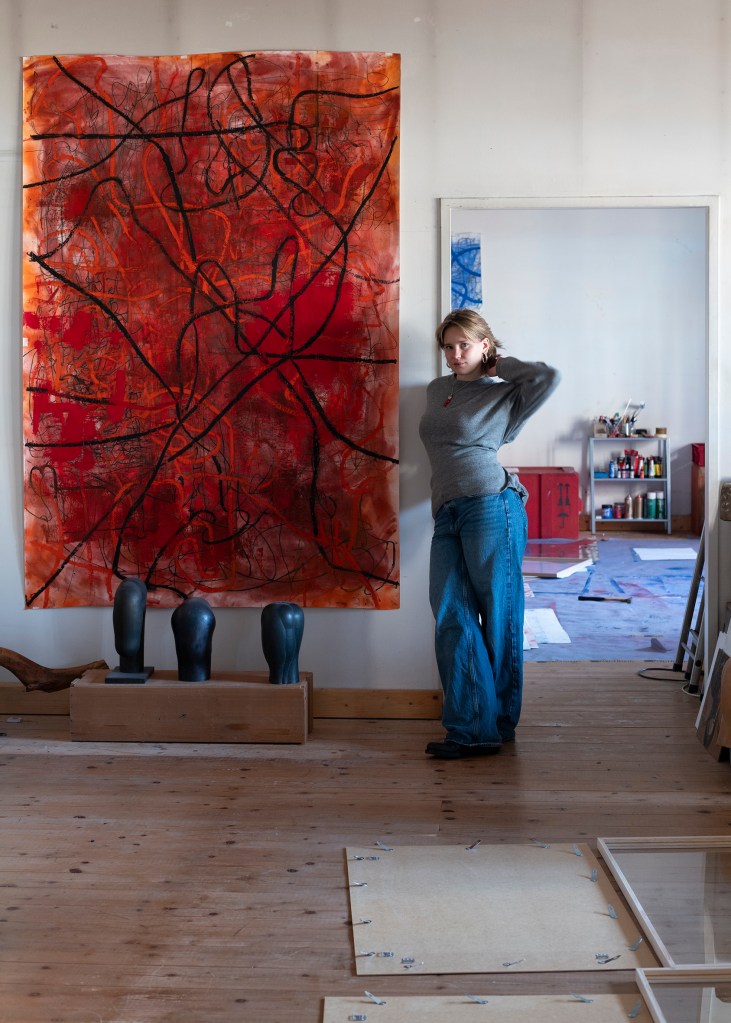
My first contact with Pia’s work was at an exhibition we were both a part of and I was intrigued with it from the first moment on. It makes you aware of the interconnectedness of all life, of all processes of all particles and parts of life. It takes you to dive deep into it’s world, accompanied by a vibrant mix of colours.
For the following I asked Pia if she wants to do an interview with me:
Luna Maluna Gri: Tell me a bit about yourself and your work.
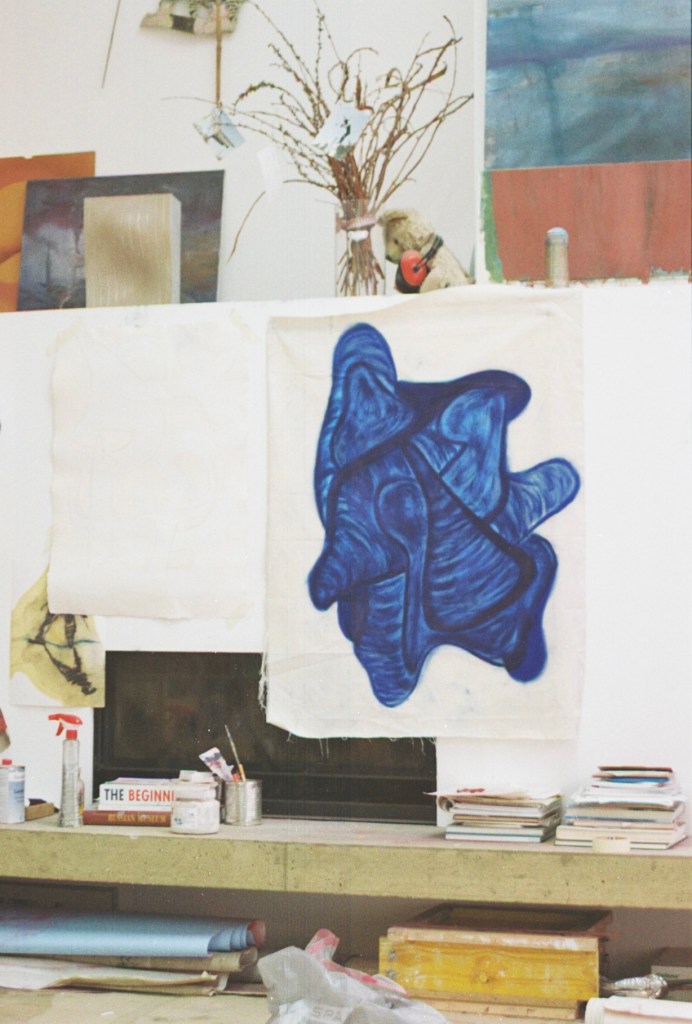
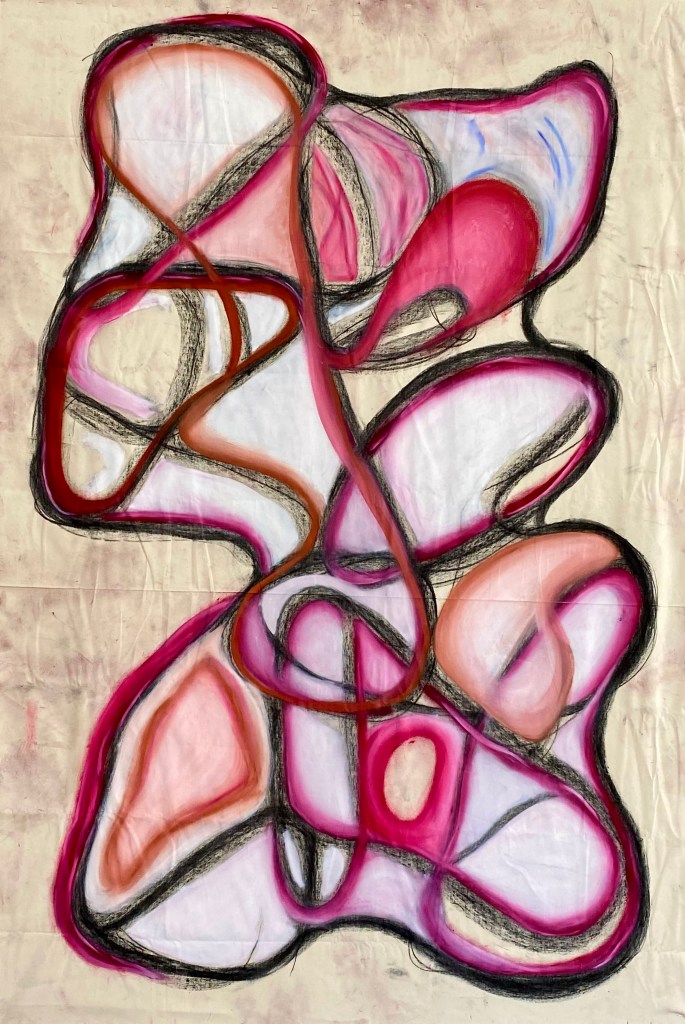
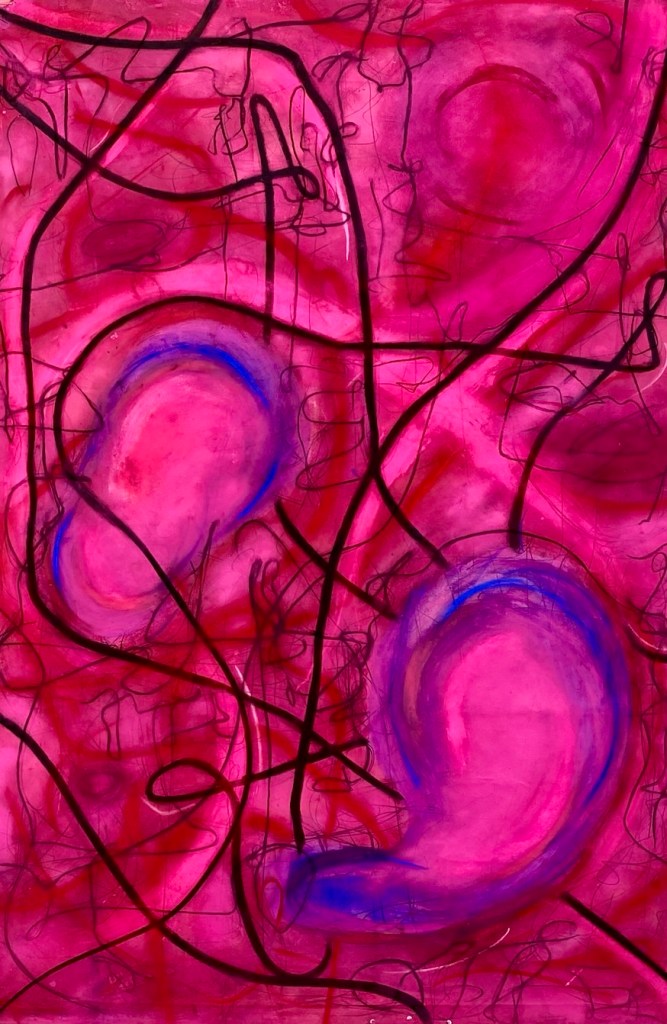
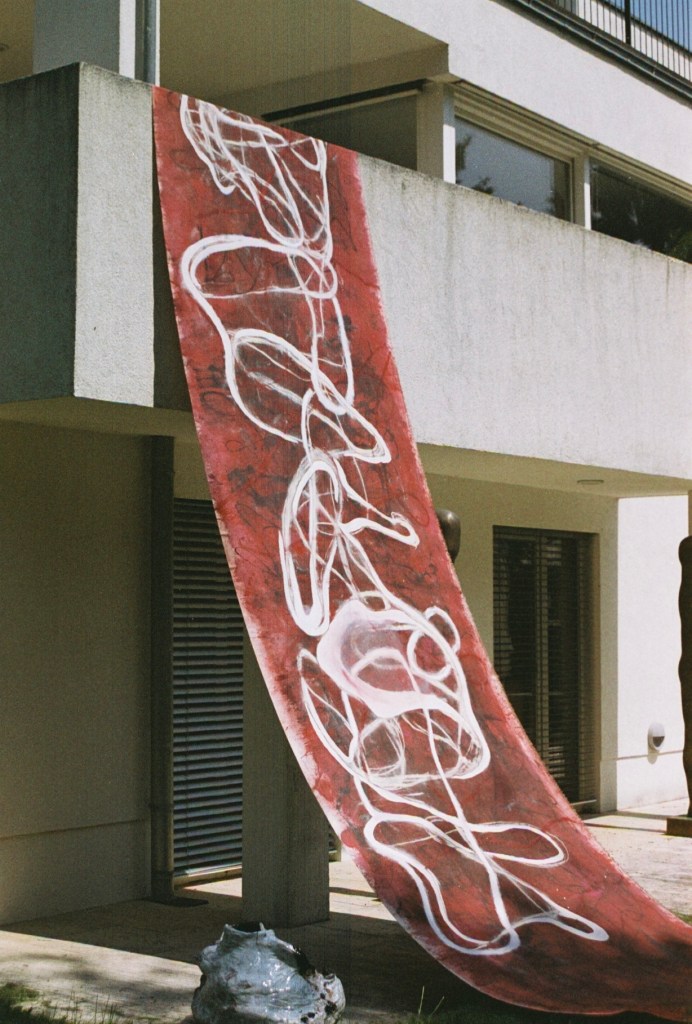
Pia Frank – Avramidis: My name is Pia Frank-Avramidis and I am an artist living and working in Vienna. Through my work, I aim to create a space where art and science overlap. It helps me to establish a connection between our internal processes and external worlds and understand them better. I am fascinated by how these invisible processes manifest themselves through us humans and ultimately shape our reality. Many of my paintings begin with scientific observations, which I then translate into visual forms. For me, painting is a way of thinking and researching. Structurally my works often resemble cells, as I see them as part of a growing organism that constantly absorbs its surroundings, taking in and transforming external influences. Through this process, I try to explore and give form to the complex connections between body, consciousness and emotion.
LMG: How and why did you start creating art?
PFA: My mother and both of my maternal grandparents were artists, so art and creativity have always been part of my everyday life. I was always allowed to be in my grandparents studio while they worked – sometimes I worked on my own projects, sometimes I was allowed to help them with theirs. Growing up and experiencing first-hand how someone expresses themselves and their thoughts through artistic craftsmanship was therefore always the most natural thing in the world for me. That’s why my most natural form of expression is painting. Ultimately, however, I only started painting again when I moved to Amsterdam to study biomedicine. I had always been interested in how people function and was determined to pursue my own research, but after studying there for a while, I realised that painting was the only way for me to absorb and process my interests and what I had learned.
LMG: What role does creating art play for you?
PFA: It is pretty simple, I just cannot do without it.
LMG: What does your creating process look like?
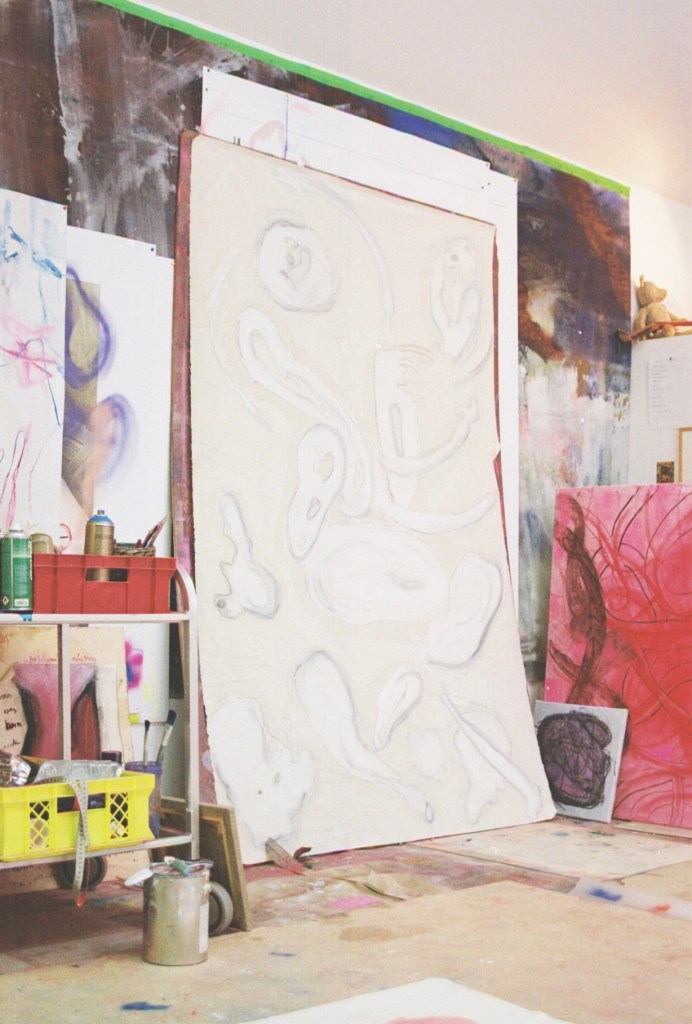
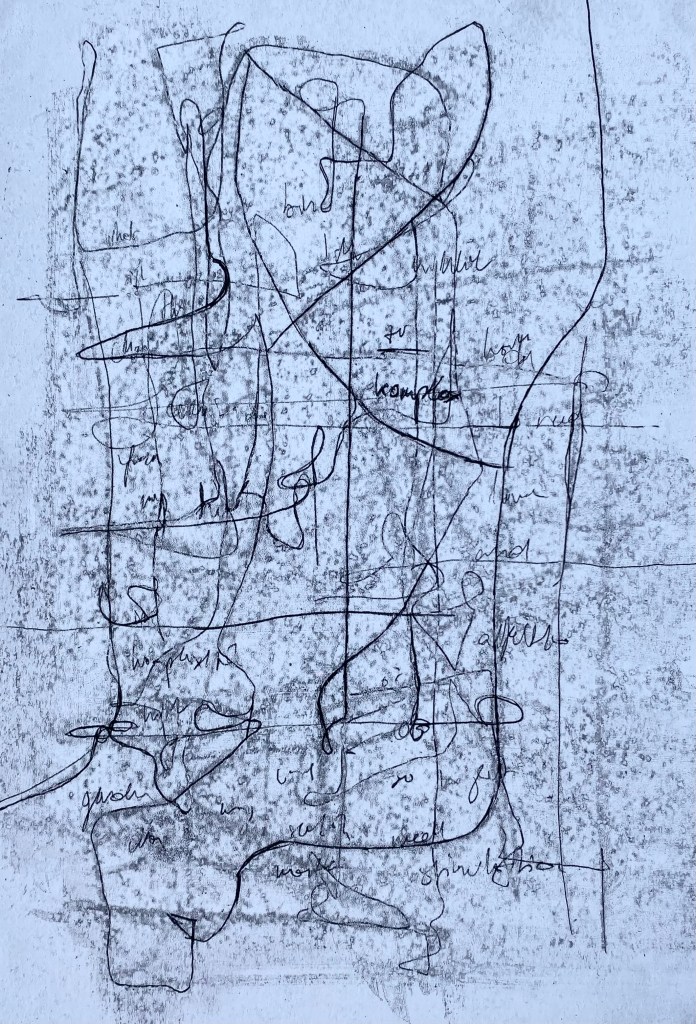
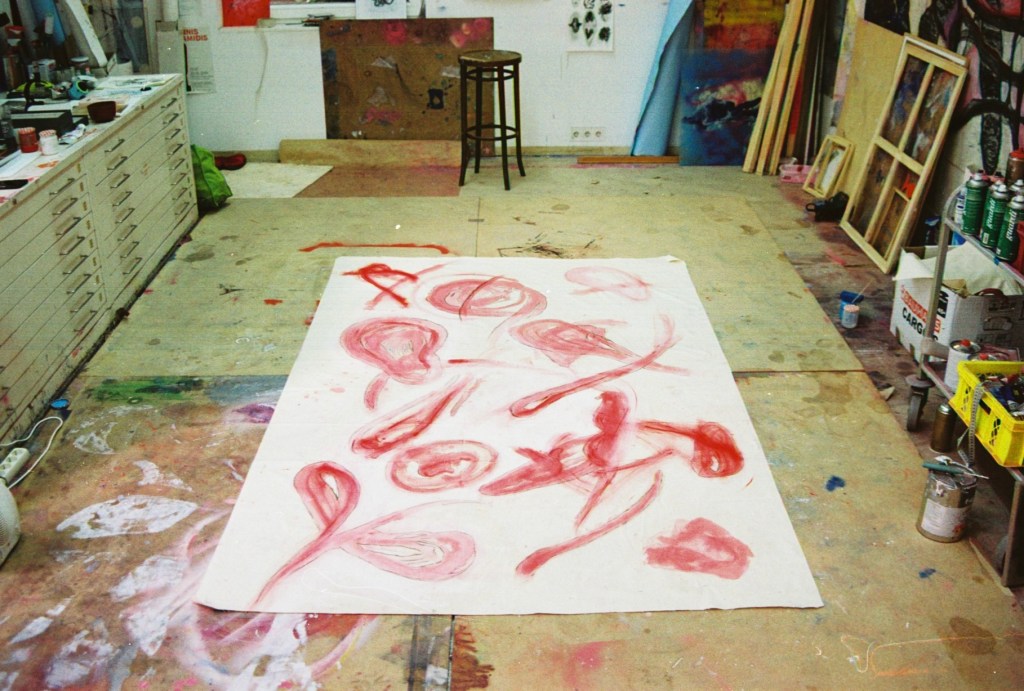
PFA: My process is never completely clear and more like a structured chaos. I observe my surroundings a lot and tend to draw my thoughts out like a written sketch or a map. Usually, when I start one painting, it doesn’t stay just one painting. The original thought branches out and creates several new directions growing from it. Each work carries something from the previous one, but it also changes like a mutation. It’s like growing a cell culture. You isolate a small part, introduce something new and suddenly a completely new form develops. Though my actual process ofpainting is very instinctive. I follow the material and my first impulse. From there, the artwork begins to guide me, and at some point, it feels like it develops its own logic.
LMG: What inspires you?
PFA: It can be small things that occur in everyday life or nature, topics I learn at university or pick up in conversations. It’s less about what the source of inspiration is and more about the process that comes with the stimulation. I am very interested in the human body on a biological level and in the human psyche. Biological systems and the fragility of the body, how people construct themselves and where the line between the ego, the self and being is formed and blurred. How one could establish a connection between the physical and metaphysical aspects of thoughts and microbiological processes. Visually I am drawn to structures, especially the ones we often overlook. Organic formations, biological systems, patterns that repeat themselves in different scales. I also take a lot of inspiration from histology books. I’m fascinated by how life organizes itself, how something microscopic can mirror something vast.
LMG: What is your experience with the art world?
PFA: I was taken to exhibitions and various art fairs from an early age on and have worked in galleries since I was fourteen. In combination with my studies in art history and organisation of independent exhibitions, I have already experienced many sides of the art world. Like any other market, the art market is quite complex. On the one hand, it holds wonderful aspects, artists who support each other, galleries and institutions that promote and assist you, but there will always be people who demotivate you, compete with you or take advantage of you. These realities make you very aware of the structures within the field. However, I firmly believe that the most importantthing is to remain true to yourself. As artists, we do not create for the market, and the market does not determine us – rather, we determine the market. I think that, first and foremost, we must always ensure that we treat each other and each others work with respect and as equals. This also means being prepared to break new ground and let go of what no longer works. What I appreciate most though, is the exchange with other artists and the openness and sharing of techniques and processes. Having these connections and conversations have enabled me to see myself and my own work differently and to grow in it.
LMG: Is there something you want to change about the art world? If yes, what and why?
PFA: I would love to see more artist-run spaces and galleries, places created and maintained by artists themselves, especially run by woman and female artists. There is something incredibly powerful about this independence and shared responsibility.
LMG: What do you think is/are the role/-s of artists and art in our society?
PFA: I believe artists and art to be a fundamental and necessary part of society. What makes art so powerful is that it can reflect every aspect of life. It can show beauty and hope, but also discomfort, conflict and the things we might prefer not to see. It creates space for reflection. I think of art as a catalyst for the mind. It stimulates thought, emotion and dialogue. And artists, in a way, act as messengers – observing, translating and reflecting what is happening within and around us.
LMG: What artist/artists would you like to meet (dead or alive) and if you had one question what would you ask them?
PFA: There are so many artists I would love to meet. One of them is Patti Smith. A few years ago, my godmother took me to one of her concerts. Ever since I’ve been deeply fascinated by her work, her texts, her music, her books and her drawings. I admire how she moves so freely between disciplines as a singer, songwriter, poet, painter, author, and photographer. If I could, I would love to spend a few days with her – simply exchanging thoughts.
LMG: Is there something you want to achieve in your art life? Dreams? Future plans? Or projects you would like to do?
PFA: I’m very drawn to the idea of working in a laboratory again, collaborating with neuroscientists or psychoanalysts. Bringing art into dialogue with science, especially in relation tothe mind and perception. My general goal though is simply to continue evolving, to keep learning, questioning and creating.
LMG: Do you think there is something you can bring to this world through your work as an artist which you couldn’t in any other field of work?
PFA: Yes, I do. I think art allows us to express things that cannot be communicated in any other way. There are layers of experience that language can’t fully capture. I hope to give people a reason to break life down into its smallest details, to question it and to examine it. But at the same time, I also hope to create space to simply be.
Credits:
Portrait photo: © Oskar Schmidt
All other photos and all artworks: © Pia Frank – Avramidis
Instagram: https://www.instagram.com/piafrankavramidis/
 Art Uncovered
Leave a comment