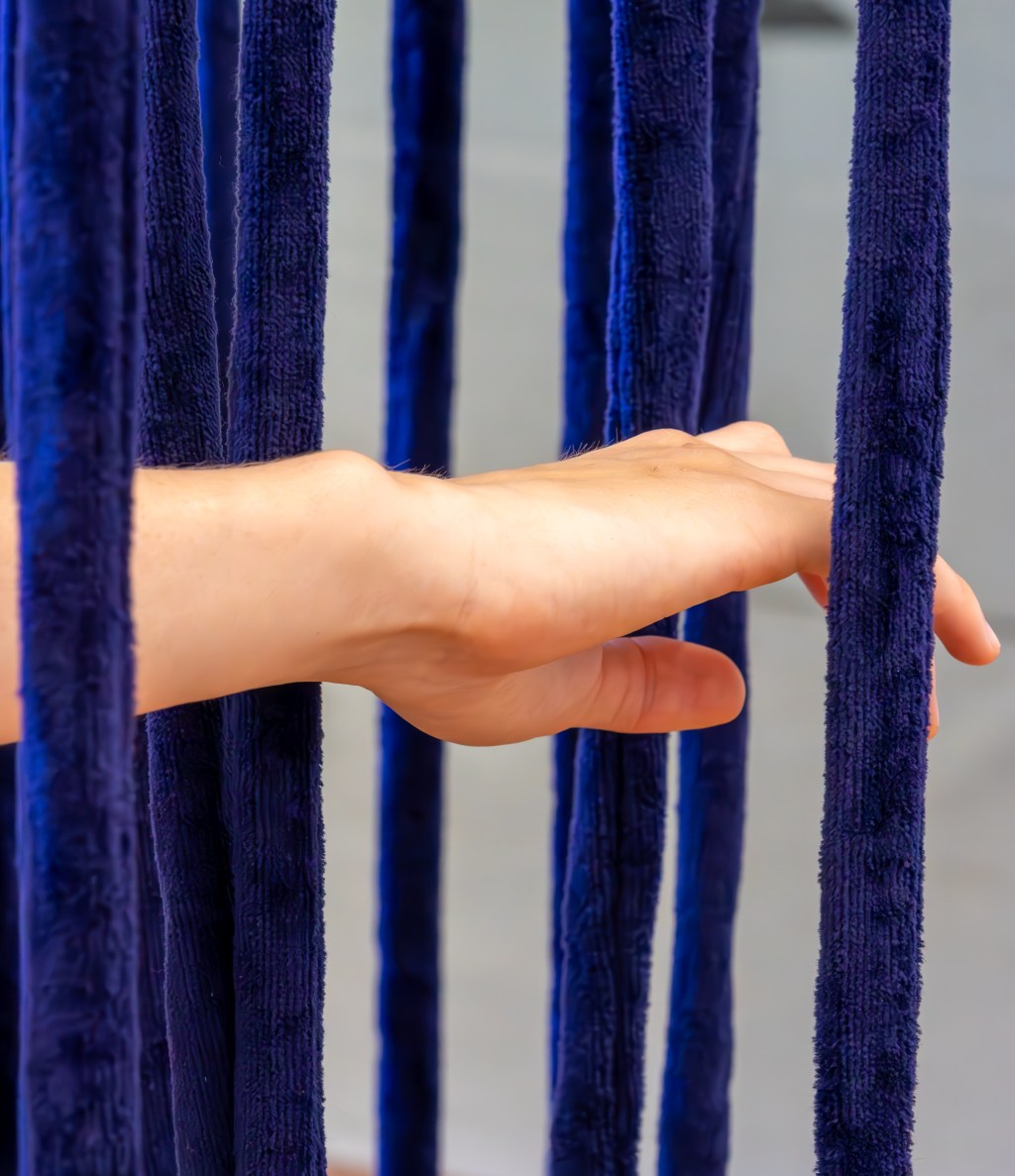
I have come across Sabina’s work through Instagram and was intrigued by it from the first moment on. The soft qualities of the textiles in connection with topics which make you think, result in very interesting and moving work. All being wrapped into radiant colours and a touch of playfulness.
For the following I asked Sabina if she wants to do an interview with me:
Luna Maluna Gri: Tell me a bit about yourself and your work.
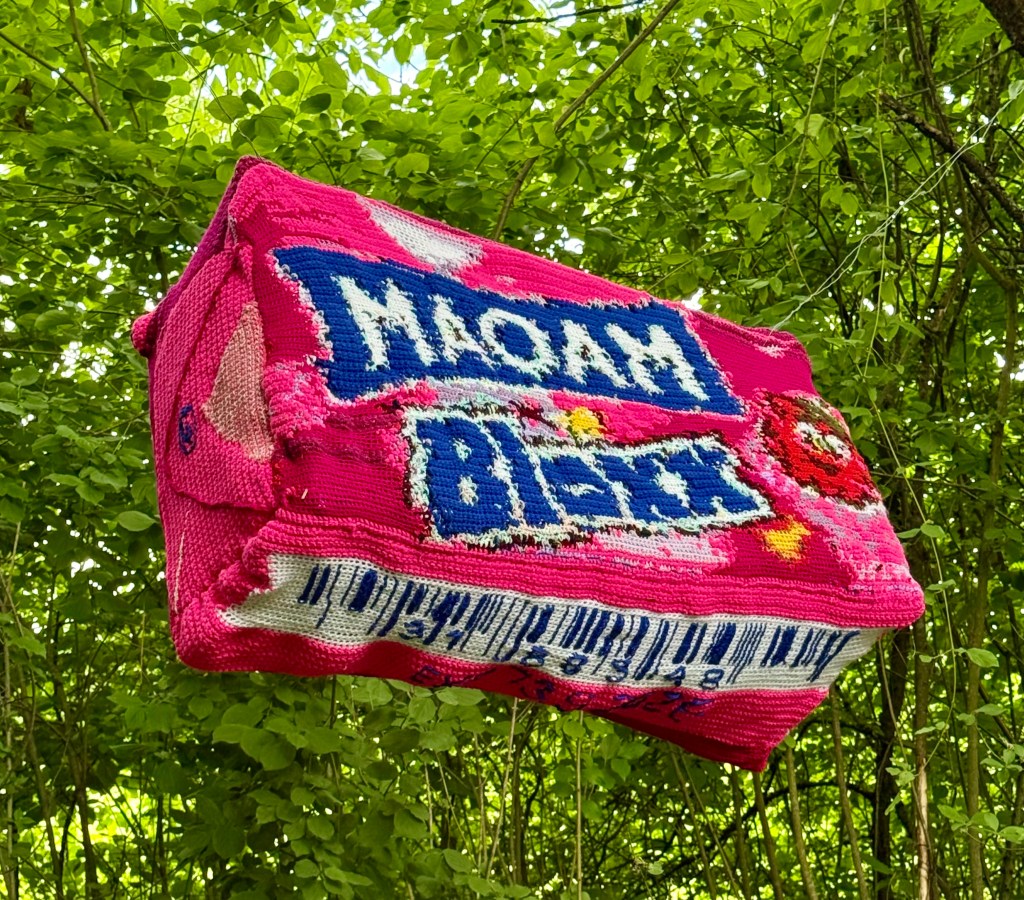
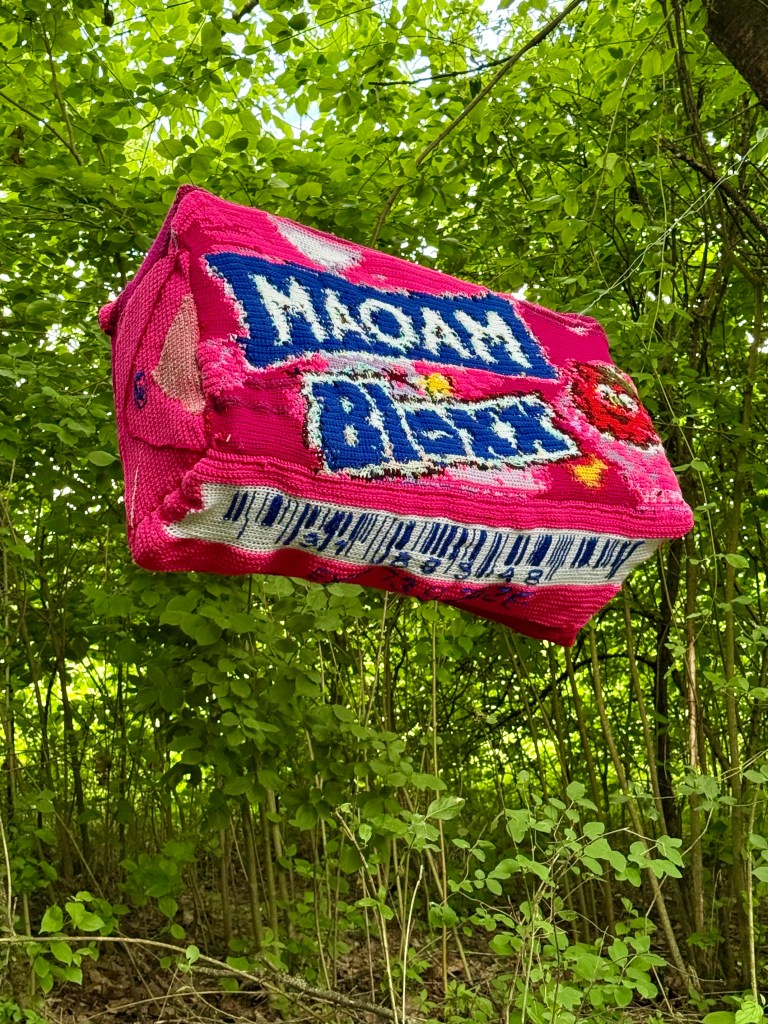
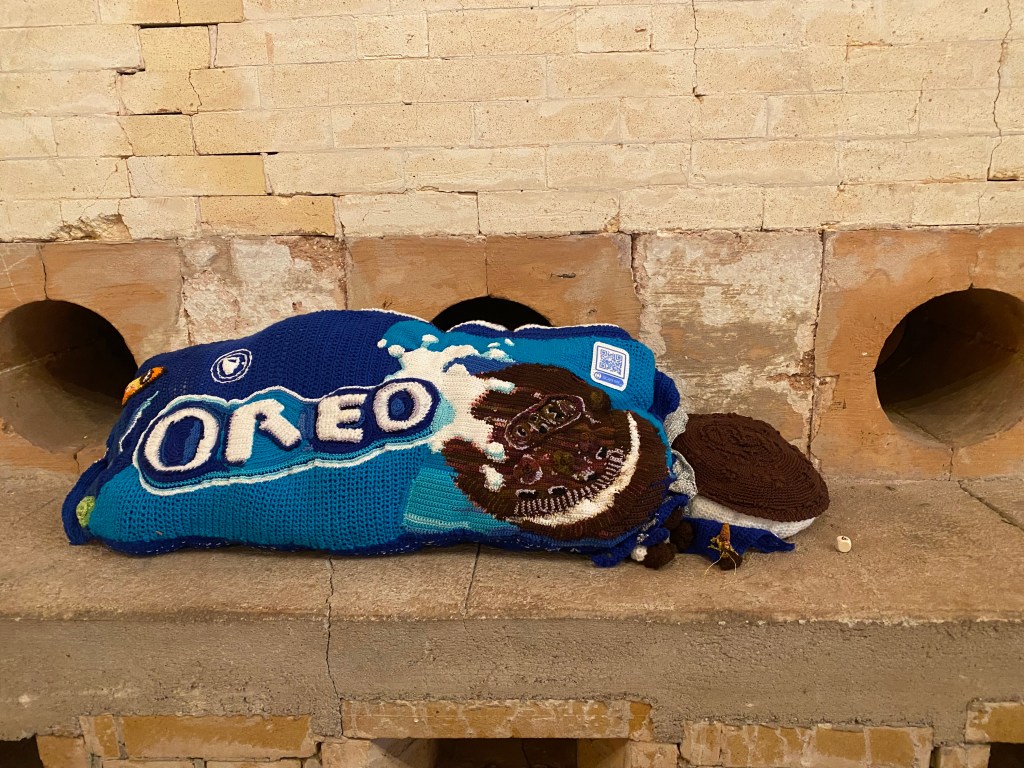
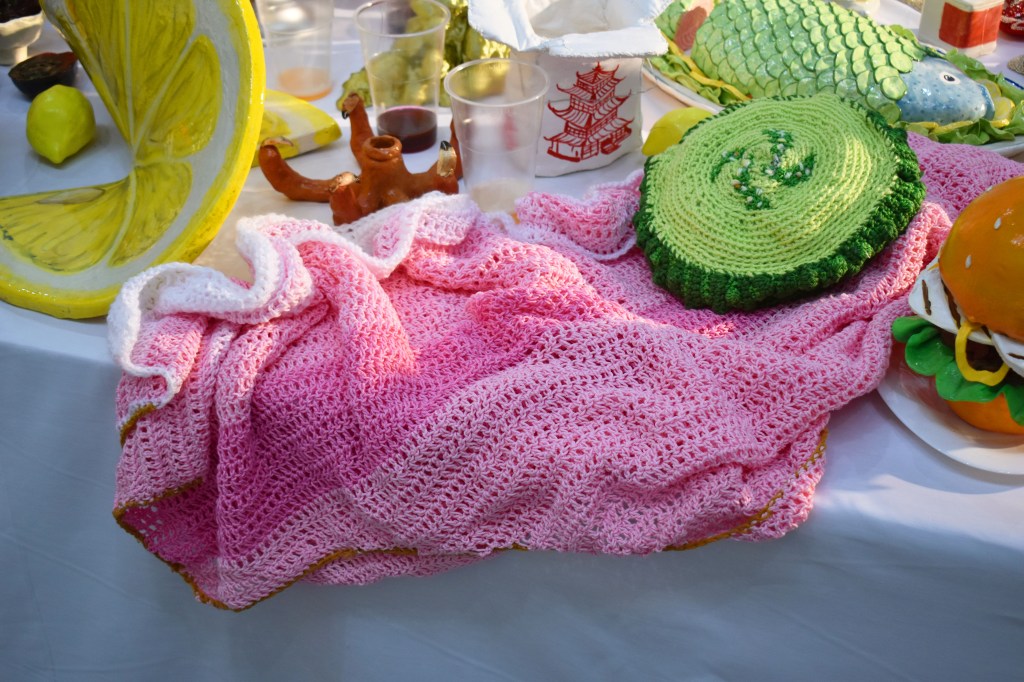
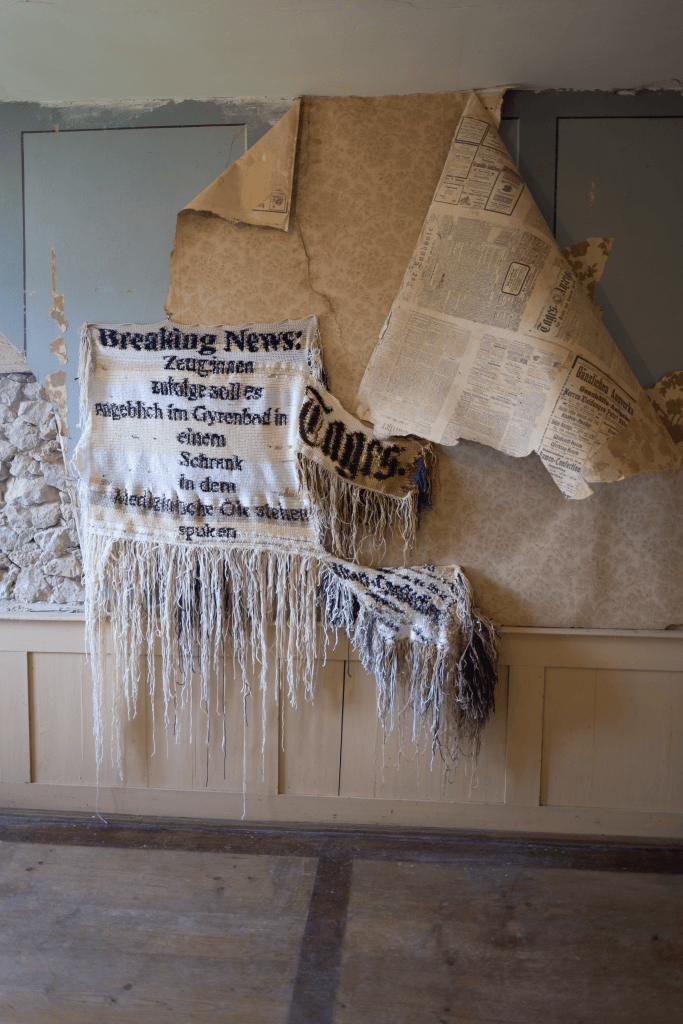
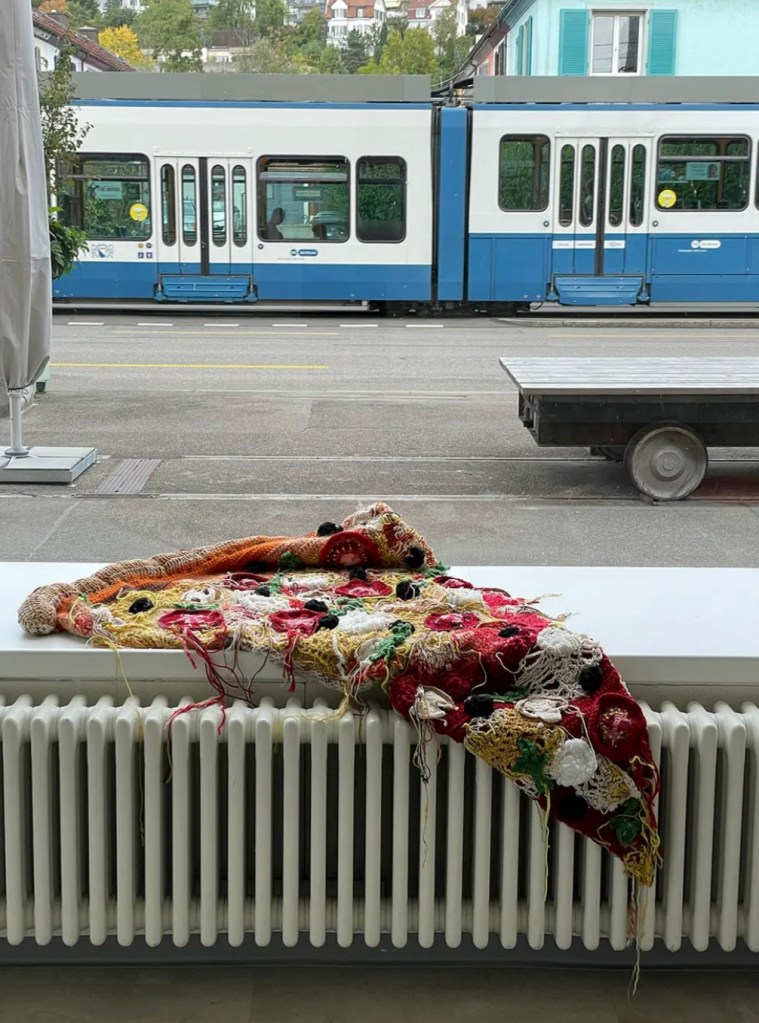
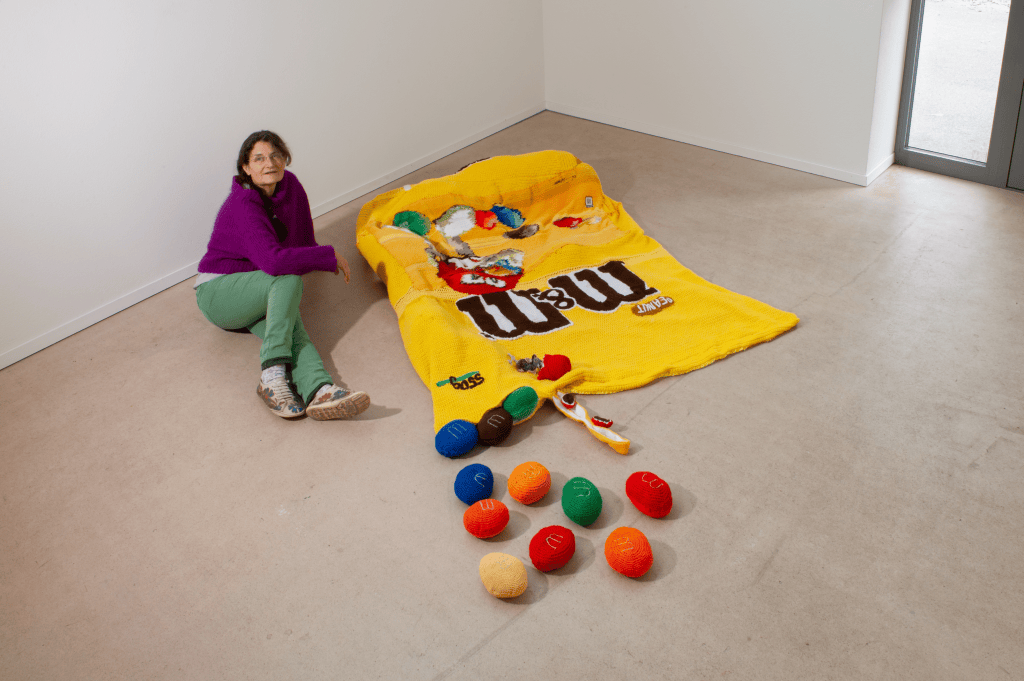
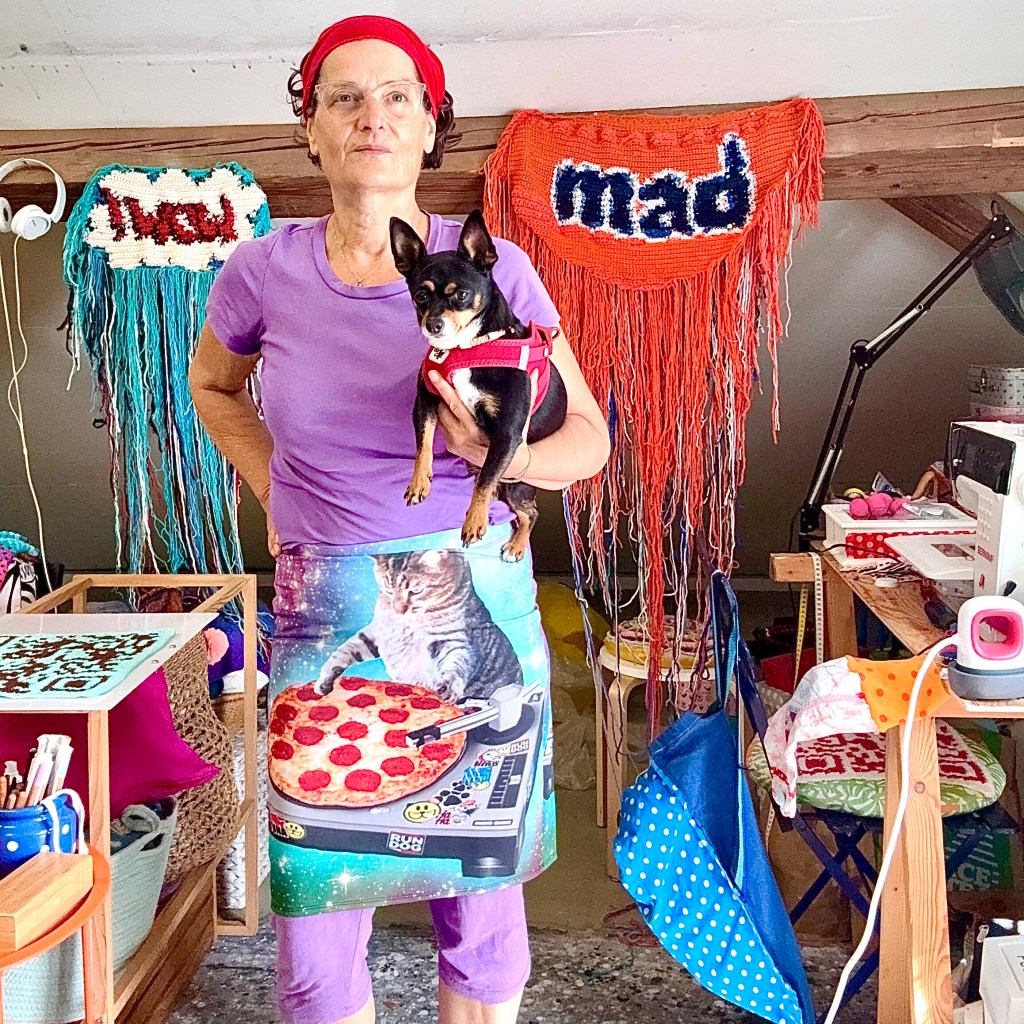
Sabina Speich: I’m Sabina Speich, a mixed-media and multimedia artist based in Winterthur, Switzerland. My work doesn’t fit neatly into one category, and I don’t want it to. I work with textile, crochet, conceptual art, performance, participatory projects, video, digital media and whatever else an idea requires. My recent work includes large-scale crocheted food sculptures and text-based crochet pieces that combine humour, absurdity and social or political commentary. I also work with found and discarded materials, plastic I pick up while walking my dog, leftover yarn, cardboard, things that have already had another life. I’m interested in what we consider valuable and what we discard – materially, socially and culturally. My experiences of chronic illness, neurodivergence, being genderfluid and living outside many expected norms inevitably entermy work. Humour is very important to me. So are resistance, Crip Theory, queer experience, social injustice and the refusal to fit neatly into categories.
LMG: How and why did you start creating art?
SS: I was born an artist. I grew up in an artistic family, so art was never something separate from life. My whole environment was shaped by it. Creating was simply part of how I existed and how I understood the world. There was no moment when I decided to become an artist. I already was one. Later, I studied art formally first at art schools in St. Gallen and Lucerne, then Media Art and finally Art in Public Spheres. But my education didn’t make me an artist. It gave me additional languages, tools and possibilities for something that had always been there.
LMG: What role does creating art play for you?
SS: Creating is survival. That may sound dramatic, but for me it is quite literal. I have lived with chronic illness, pain, exhaustion and difficult experiences for most of my life. There have been many situations in which possibilities were taken away from me or my world became smaller. Creating is the thing that remained. Art gives me a space in which I can transform things instead of simply enduring them. Pain can become something absurd. Anger can become humour. A discarded material can become valuable. Something that is considered a flaw can become the centre of a work. Art has helped me stay alive, curious and defiant.
LMG: What does your creating process look like?
SS: Chaotic! I usually have about a million ideas at the same time. Often an idea appears first and then I start looking for the material or medium that can carry it. But it can happen the other way around too. I find a strange piece of plastic on a walk, someone gives me leftover yarn, or I see a material and suddenly there is an idea. I don’t believe an artist needs to be loyal to one material or technique. The idea decides what it needs. Crochet has become particularly important to me. I originally learned it during hospital therapy, and something that could have remained a therapeutic handicraft became an artistic language – and eventually a form of activism. My process isn’t particularly tidy, and neither is my work. I like that. I leave threads hanging from crochet pieces instead of hiding them. The unfinished, imperfect and excessive parts are allowed to remain visible.
LMG: What inspires you?
SS: Everything. And I mean everything. Politics, ridiculous everyday situations, my body, anger, humour, conversations, injustice, things I find on the street, the internet, pop culture, people, materials, illness, activism, a piece of rubbish, a sentence that annoys me, something beautiful, something completely stupid. I don’t have an on/off switch for inspiration. My problem is not finding ideas. My problem is having far too many of them.
LMG: What is your experience with the art world?
SS: It is complicated. I have been an artist all my life and have worked professionally for decades. I have a BA in Media Art and an MA in Art in Public Spheres. I have exhibited in Switzerland and internationally, in galleries, museums, artist-run spaces and off-spaces. My videos have been shown at international festivals, I have received awards and nominations, participated in public and participatory art projects, and my work is held in private and public collections. So I am not outside the art world. And yet I have repeatedly experienced what it means not to fit its expectations. I am genderfluid, in my sixties, chronically ill and neurodivergent. My practice also doesn’t fit comfortably into one marketable category. I crochet, but I am not simply a textile artist. I make conceptual work, performance, video and participatory projects. I can make something deeply serious and completely ridiculous at the same time. I have often had the feeling of having to prove over and over again that what I do is enough to be taken seriously as art. That contradiction having a long professional practice and still experiencing exclusion – is something I carry with me.
LMG: Is there something you want to change about the art world? If yes, what and why?
SS: Yes. I would like the art world to become genuinely more open to people who don’t follow the expected trajectory. Contemporary art likes to talk about diversity, inclusion and breaking boundaries, while its structures can still be remarkably narrow. I would like there to be less gatekeeping and less dependence on fitting into the right network, category, age group, identity or biography. Artists who live with disabilities or chronic illness, neurodivergent artists, queer and gender-nonconforming artists, older artists and people with unconventional careers shouldn’t constantly have to prove that they belong. I also want materials and techniques to be taken seriously without first having to be legitimised by the right theoretical language. Crochet can be conceptual. It can be political. It can be funny, aggressive, tender, queer, monumental or completely absurd. The material does not determine the intellectual value of the work.
LMG: What do you think is/are the role/-s of artists and art in our society?
SS: I don’t think art has one role, and I don’t think artists need another job description telling them what they are supposed to do. Art can question things. It can irritate. It can comfort. It can make something visible that society prefers not to see. It can be political, completely useless, beautiful, ugly, ridiculous or disturbing. For me, art is also a way of resisting standardisation. We live in a society that constantly tells us what bodies, identities, careers, success and even happiness are supposed to look like. Art can create spaces in which other ways of existing become visible. Sometimes resistance can also be a gigantic crocheted hamburger.
LMG: What artist/artists would you like to meet (dead or alive), and if you had one question what would you ask them?
SS: Frida Kahlo, Faith Ringgold and Louise Bourgeois. They are very different artists, but I am interested in people who found ways to transform lived experience into powerful artistic languages rather than separating life from art. If I had to choose one person, it would probably be Frida Kahlo. Her body, pain and identity were not separate from her art. She made them visible without allowing them to be the only thing she was. Knowing myself, I would probably forget all my prepared questions and just start talking with her.
LMG: Is there something you want to achieve in your art life? Dreams? Future plans? Or projects you would like to do?
SS: Yes. I want recognition. And I don’t mean that I want to be famous. I want my work to receive the recognition I know it deserves. Art is one of the few areas of my life where I know that I am good at what I do. I have continued creating through illness, pain, exhaustion, marginalisation and exclusion. I have studied, experimented, exhibited and developed my practice for decades. I don’t want to spend the rest of my artistic life being marginalised in the one place where I know I belong. I want opportunities to make ambitious work. I want exhibitions and institutions that seriously engage with my practice. I want the freedom and resources to realise ideas at the scale at which I imagine them. And I want to stop being treated as though I am somehow not enough. I am enough. And so is my work.
LMG: Do you think there is something you can bring to this world through your work as an artist which you couldn’t in any other field of work?
SS: Yes. Art allows contradictions to exist without resolving them. I can make something funny about something painful. I can turn rubbish into something valuable. I can use an old domestic craft to talk about something happening right now. I can combine a crocheted object with a QR code and suddenly something tactile and handmade opens into a digital space. I can talk about vulnerability without presenting vulnerability as weakness. I can be fragile and strong, ridiculous and serious, angry and joyful, imperfect and valuable at the same time. And I can make space for things that don’t fit neatly into the categories we are given. I don’t know another field in which I could say all of that in quite the same way. Sometimes I don’t even need to say it. I can crochet it.
Credits:
3rd photo: ©Tom Coates
4th photo: ©Erna Weiss
5th photo: ©Daniel Imbach
6th photo: ©Natalie Madani
all other photos and all artworks: ©Sabina Speich
Website: https://marvelcrochet.com
Instagram: https://www.instagram.com/tuepf_li/


Leave a comment