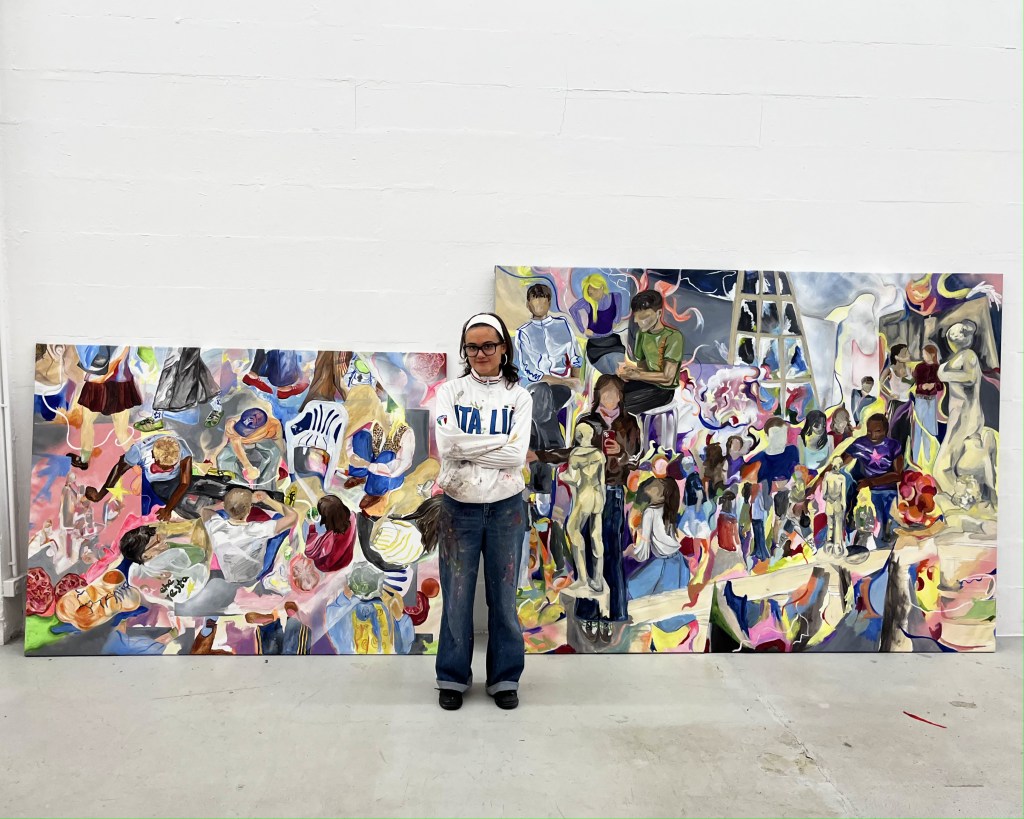
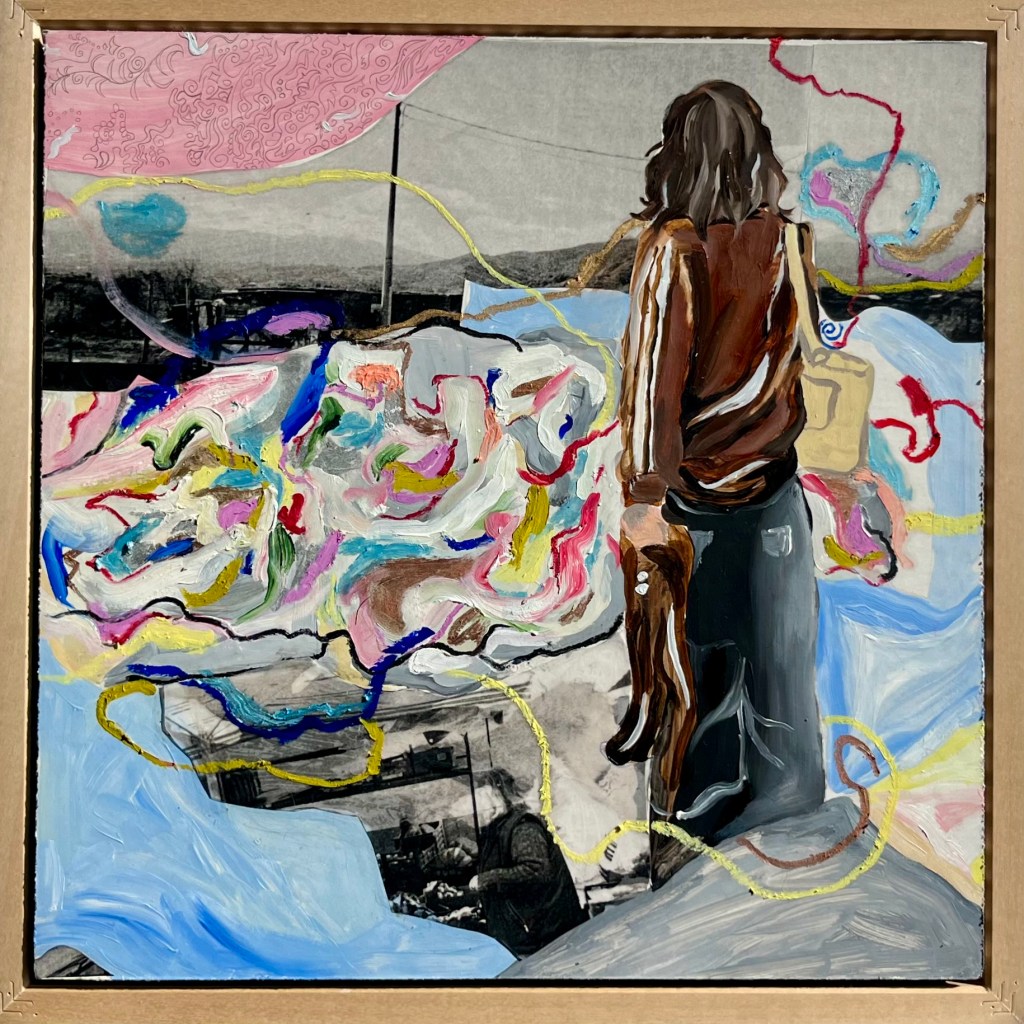
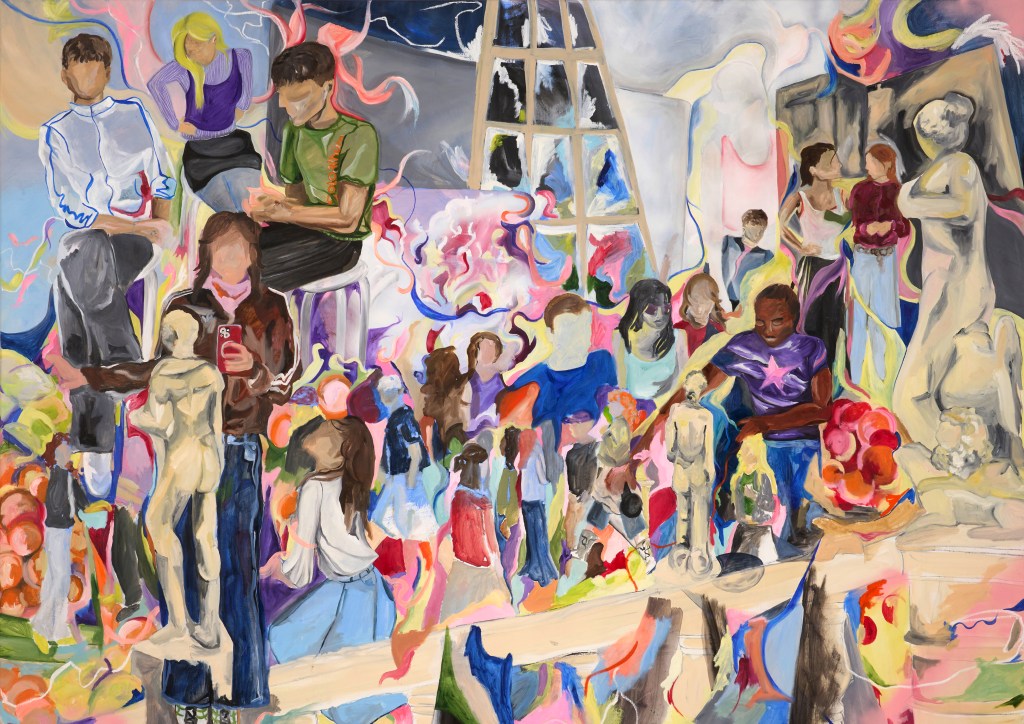
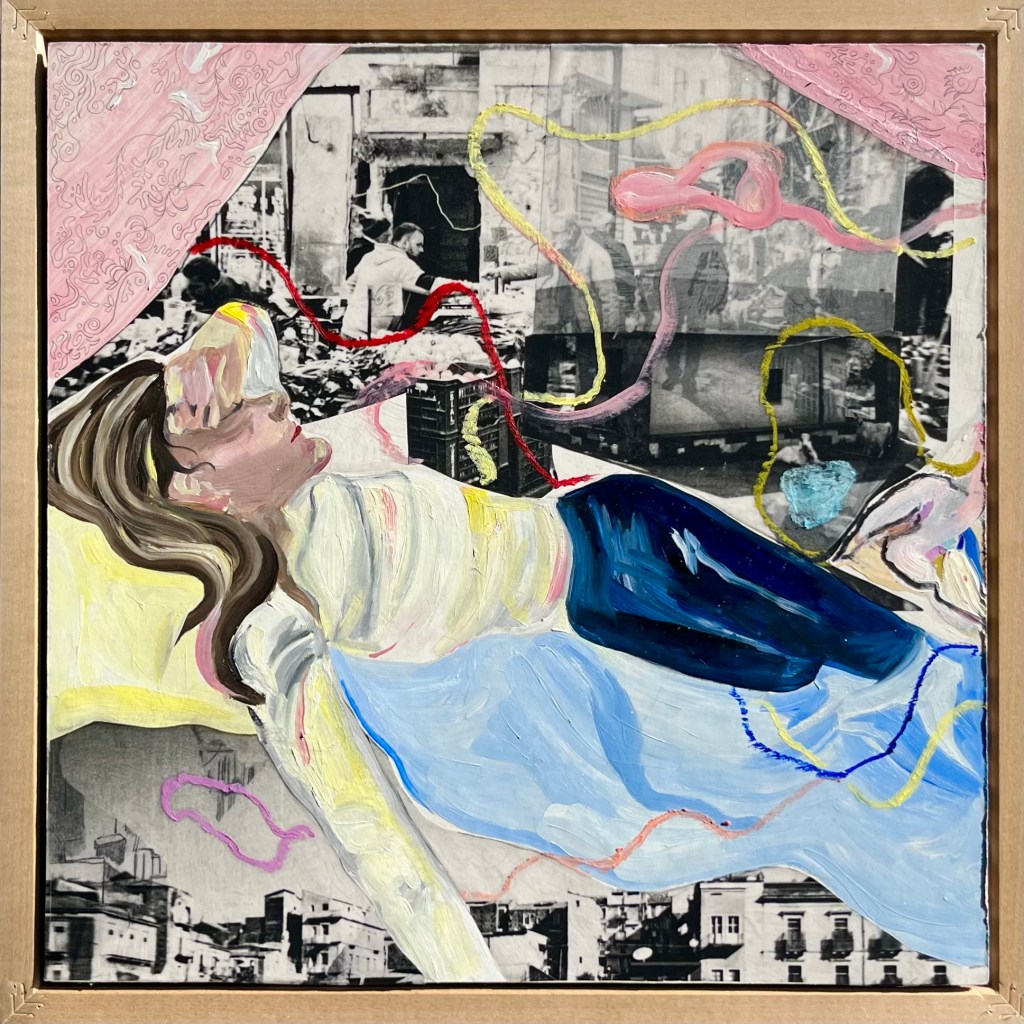
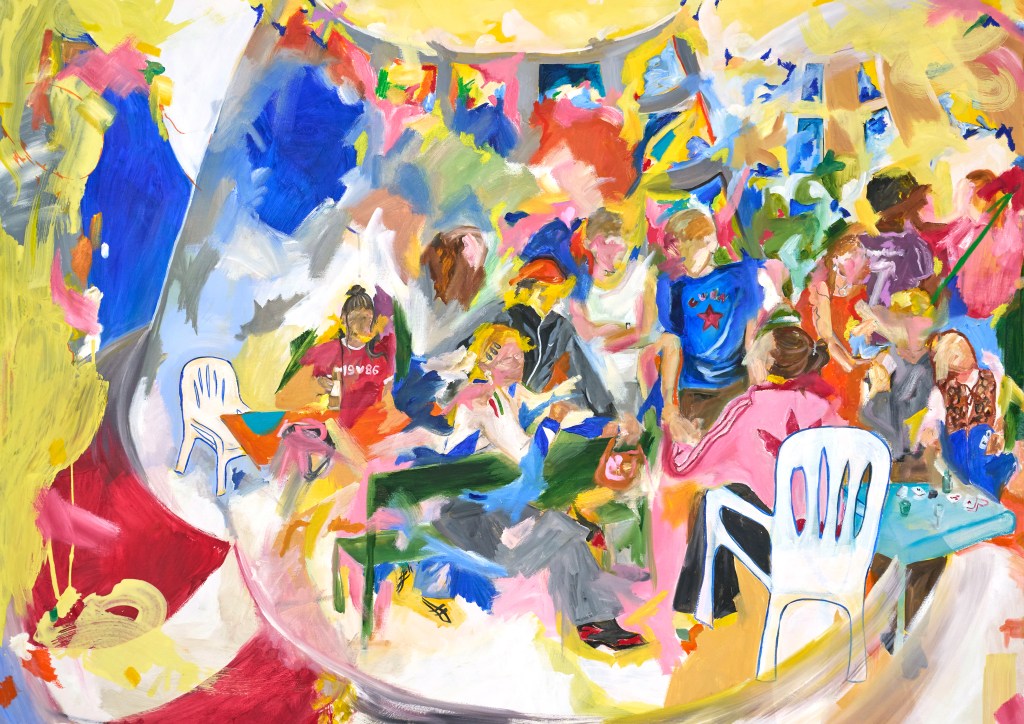
When I first saw Maxima’s work it captivated me instantly. It intertwines personal experiences, emotions with bigger topics into a dynamic dance of colours and motion, vulnerability and power. Pulsating and full of life (with everything that includes).
For the following I asked Maxima if she wants to do an interview with me:
Luna Maluna Gri: Tell me a bit about yourself and your work.
Maxima Vischer: Art always played a role in my life. The last years I worked a lot figuratively because I’m very interested in the life of people. At some point I might work even more abstract, but for now I have to process all the figures in my head. About two years ago I started with social media. On the side at first, with a rough idea behind it, because I study something else and do art on the side. At some point it then grew into something bigger. I fell into it and it ended up becoming my job.
LMG: Nice when sometimes things also fall into place on their own.
MV: I think sooner or later it would have developed like this anyway, because when I’m painting I’m in my element. I didn’t know the way yet when I started it and still now I don’t know where it’s going to lead me.
LMG: That will all fall into place eventually. Often it’s also like that, that you don’t know beforehand how the way will look like and it becomes clear when you start walking.
LMG: How and why did you start creating art?
MV: I think there never really was a specific starting point, me making art was just always there. It always was my refuge and only now, in the last one or two years, I realised how much all of this means to me and I would be totally stranded if I didn’t have this anymore.
LMG: I get that. For me making art was also always there. I tried to do other things at first (as a job) but I always came back to art.
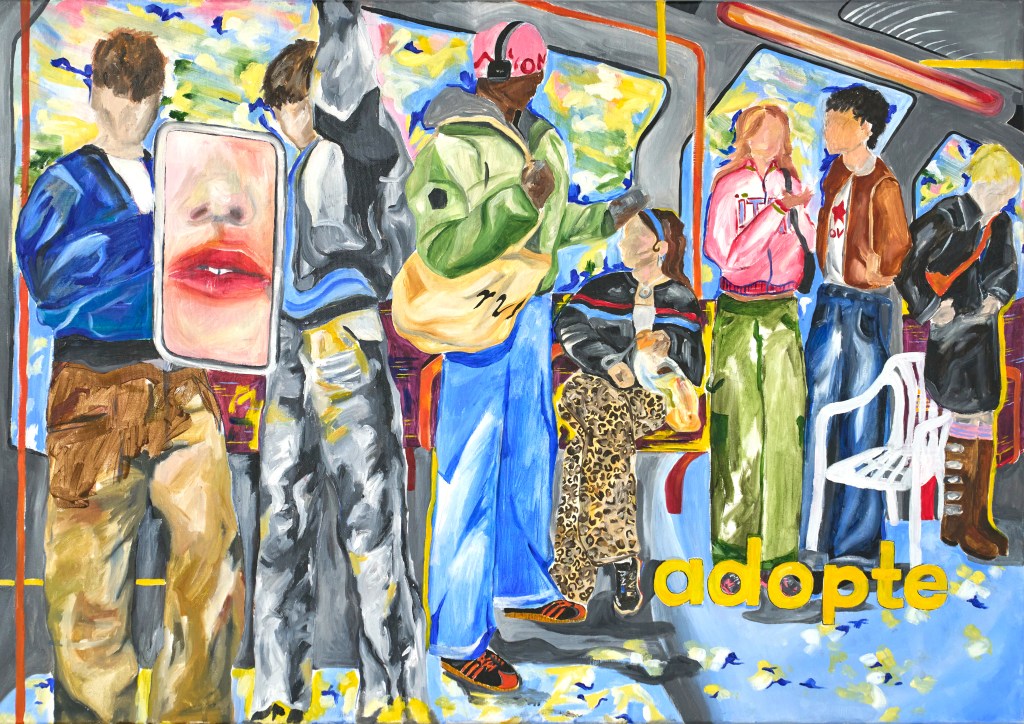
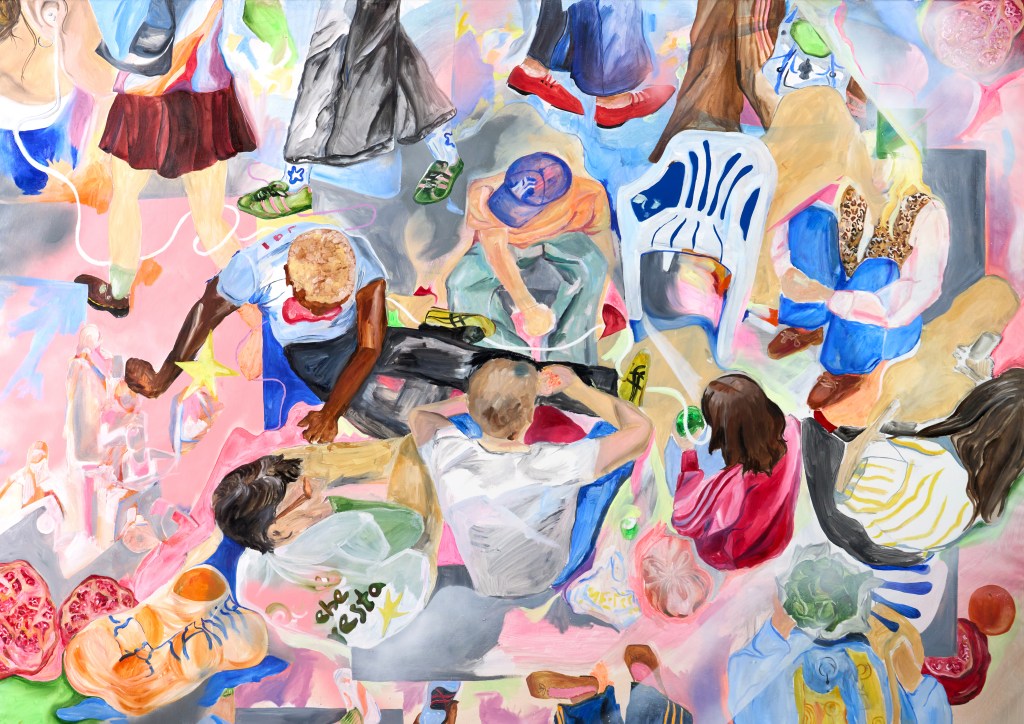
LMG: What does your creating process look like?
MV: On one hand I try to stay receptive for my emotions and the impressions around me. I study Art History which helps me to deconstruct everything theoretically and to take my time for composition and to understand historic backgrounds. Which means I can’t fully understand my own historical background but can deal with myself in the era I’m living in. I sometimes feel like that I develop something like a filter through the time we’re living in now, how I perceive everything. My creative process is always a bit of a journey. From an idea I have, taking everything in and bringing that then into my painting step by step every day.
LMG: What role does creating art play for you?
MV: For me, when creating, it’s important to speak with my voice. Because art enables me to be as honest as possible. Making art to me means being free. It enables expression and exchange and that is very important to me.
LMG: What inspires you?
MV: Actually everything, that’s also one of my biggest problems. My paintings take a long time until they are finished. Which means that I easily work three, four weeks on one idea, but in the meantime I encounter a lot of other things which I want to work on. Particularly there are two influences which prey on my mind and from which time and time again new ideas come out of, and that’s the question about origin. I grew up in Cologne with an Italian mother and German father. I often felt foreign wherever I was because there is always half of an identity inside of me which I’m never fully able to live. When I’m in Sicily, also when being with my family there, then it’s also not fully my history and I also know that I’m not alone with this feeling, but the whole thing has on a deeper level many aspects which I want to talk about, the way I’m doing it. For example my social media project. I try to use the videos democratically, as an opportunity that everyone can understand them and can contribute something to them. Which also means that content-wise I have to leave some things out or I can’t include them as a whole, but at least partly.
LMG: That’s interesting, because also I also have Italian roots, a bit further back than my parents, and I can relate to that in a way. It’s a search for identity, which a lot of people experience in different ways and which will come up again and again in different ways.
MV: Yes but I think that in my life a lot happens through regressivness. With every year I understand more why I felt this or that way as a child and still feel that clearer within me than I thought. Because, even if the language (Italien) was withheld from me, a part of me will always be Italian. Because I never had that bridge to translate into german, I could never fully grasp it and through that also have no identity in it, which is so sad.
LMG: What is your experience with the art world?
MV: There are two things because on one hand I think that the borders and barriers are too big. Admission prices for museums, explanatory texts besides the artworks, etc. are way too inaccessible. On the other hand I see a big opportunity in social media to open up the art world and reach people, although through the phone and in no way replacing a museum visit. I wish that someday both of these ways work together organically.
LMG: I understand that and the longer I’m within this system, the more exhibitions I’m a part of, the longer I study, the more I struggle with this system. Because I love exhibiting, being part of exhibitions, I love visiting exhibitions, having the opportunity to be a part of that, but on the other hand, it’s still a certain bubble you move around in. Hard to get into, partly very elitist, so for many people not accessible and certain barriers still exist.
MV: Absolutely. Seeing art in exhibitions is a barrier for many people but also it’s also not really talked about. I don’t know if dissolving these borders is even realistic. I think what would already help is a broader awareness for these social inequalities. And other art and cultural spaces should get more attention and funding, so that the elitist art system doesn’t tower over all art and cultural production, but rather a balanced counter-space develops.
LMG: Is there something you want to change about the art world? If yes, what and why?
MV: The accessibility for people. In every museum through the texts, language, the whole system,who can’t hold all people correctly anymore. And within the system something would also have to change because a lot of people don’t have time to go and see art. Art institutions and social media usually don’t go hand on hand for me but in this case I think social media could really be a platform and provide the possibility that everyone can access it. It also has it’s limitations and it can of course never replace seeing an exhibition in person and meeting real people, but it’s a first space where you can come in contact with art without knowing anything about art beforehand. I also noticed when doing exhibitions, etc.; if you are not part of a, for example, art institution, then you don’t know what’s going on in the art world. Because it’s such a closed circle.
LMG: Something else just came to my mind regarding social media. I have an ambivalent relation with social media, Instagram in particular, and also posting my art on there, etc. Do you sometimes feel like (or have difficulties with) you have to do certain things so people see your content or that it gets reach? If that’s important for you.
MV: Yes I do. I create my videos in a specific way because I play a kind of avatar I would say. At the moment I also have a difficult relation with this App (Instagram) because the videos also change for me through the algorithm. Everything gets faster and faster and it’s very hard to follow. I also recognize that I’m reaching the limit of my capacity of making art. A painting of mine takes four months. Until I post the finished painting, the algorithm has already forgotten about me. Social media opens a lot of doors but it’s also hard to bite through that.
LMG: That’s also what I noticed. Because I also make, for example, bigger drawings which take longer until they are finished and I also thought: First of all filming the whole process is exhausting in itself and I’m not sure if it rather is disturbing to my creating process than doing something helpful. And posting something just for the sake of it and so the algorithm doesn’t forget about me is also not the true essence of why I create. How do I deal with this situation now? Because it can be a more democratic way to bring art to people but it’s also difficult because of the way social media algorithms, etc. work now. Everything is so fast paced and the algorithm, in contrast to for example 2018, where all of that was still different, has become so much more chaotic and non-transparent.
MV: It helped me to separate my work, so painting, from outside things and the digital space. So separating the real world from digital space – for me those are two different rooms where something emerges and is effective. I also have two friends who create my videos, meaning they help me with making the script. They script the text for me so that the process as a whole is separated for me from the start, because my thoughts are collected in order and so is the order when I read the text, film the videos, etc.
LMG: What do you think is/are the role/-s of art and artists in our society?
MV: I think art always provides a chance to encounter and confront yourself. What does it mirror back to us? I also like that ingrained in art is something anticapitalistic. It doesn’t necessarily have something like a function, but just exists for oneself. It’s connected to your own individualism and the moment you exist in. That’s why I believe that art will always be important, because it’s natural for people that they want to express themselves this way. I think the purpose of artists and making art is to act as a filter in our world, in the present and to stay attentive for what happens around us. Art works on their own can’t make politics but they can act as conveying players in discourses and through that contribute to change.
LMG: Yes definitely, I also think that art will always be important. I do not think much of allegations like „art is not important“ or „we don‘t need art and AI can do all of that anyway“.
MV: Exactly! AI can’t do that! Art not something machine-made but rather a communication tool.
LMG: I also think that art is more important for us than many people even realise. There often are distinctions what counts as art and what not and especially traditionally there is always this distinction made between fine arts and for example literature, music, film, etc. I count all of that as art.
MV: Or also everyday objects, design, my mug, etc. Before the term ‚design’ came up, all of that was also seen as art. Everything of that counts as art, also fashion, etc. That will always be important and we are surrounded by more art than we think.
LMG: Which artist/-s (dead or alive) would you like meet and if you had one question what would you ask them?
MV: Louise Bourgeois for example. Her memoirs were the first artist book that I read and I inhaled it. I was sixteen and was like: „Oh my god that’s so honest.“ I wouldn’t ask her anything and just watch how she works. Other than that, I really like Tracy Emin. I visited Tate two weeks ago and saw her exhibition there. That moved so much. She still moves so much in the art world. I also wouldn’t want to ask her anything and just watch how she works.
LMG: Is there something you want to achieve in your art life? Dreams? Future plans? Or projects you would like to do?
MV: On a meta level I would like to bring even more to the outside what I feel and think. I hope that through approachable storytelling reels people feel interested and welcome to look into art and art theory. I want to open up the industry. Longterm I want to get even better to make explanatory and process videos for my paintings.
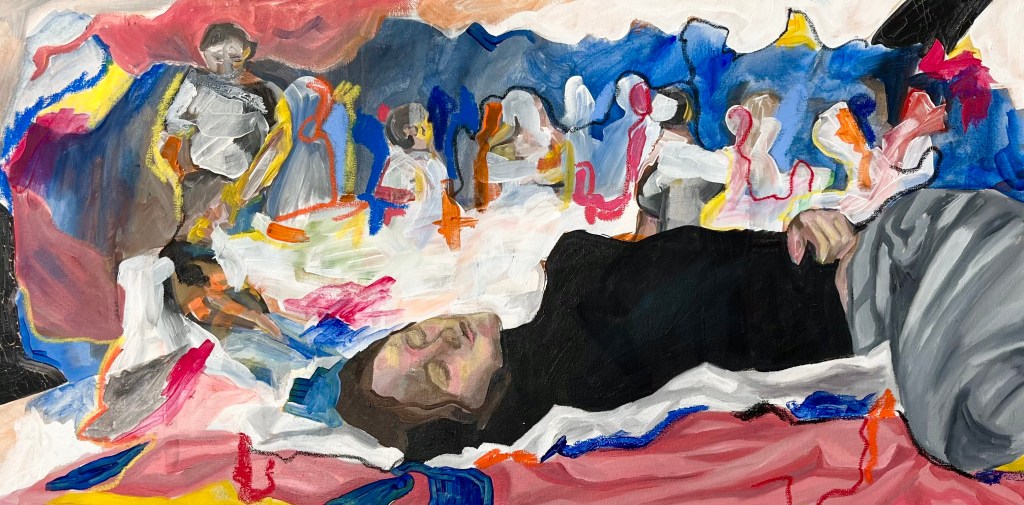
LMG: Do you think there is something you can bring to this world through your work as an artist, which you couldn’t in any other field of work?
MV: Through art I can bring my voice into the world in the most honest way. I sometimes feel like as if I would take myself to seriously because I create art or painting often is seen as if avoiding doing other kinds of work. But if I let go of all these insecurities and feelings of guilt to be able to do what I do, then I think painting has the power to communicate without language and that is special to me.
LMG: I get those thoughts and also have had them myself but just creating something is fundamentaly human, something every human does in a way and which is very important.
MV: The only thing that would help me with these thoughts of doubt is being even more honest when working on my paintings, to dive even deeper.
LMG: And that’s also a process and takes courage to dive into that, to show it to the world and people.
MV: I definitely still have to find my voice.
LMG: To find your voice is a longer process for a lot of people I think. Also, I believe you find your core voice but further then that you always also change throughout your life and find your voice again and again in different ways. I don’t think that there is any point in life when that process is fully done.
MV: I also don’t think so.
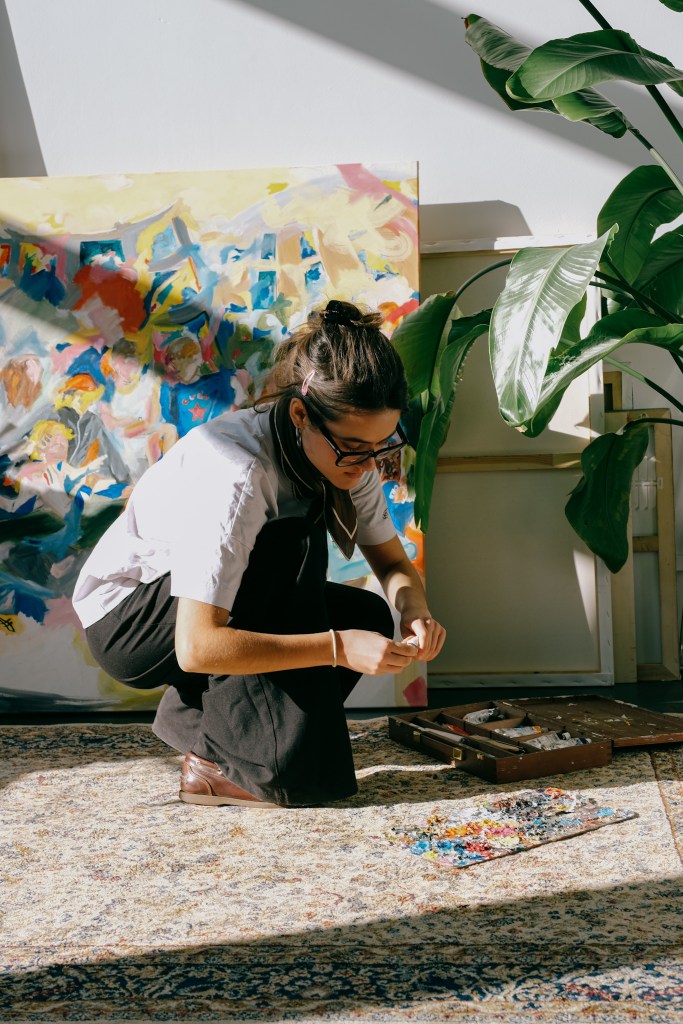
Copyright to all photos and artworks: Maxima Vischer
Website: https://mvxima.de/
Instagram: https://www.instagram.com/mvxima/


Leave a comment